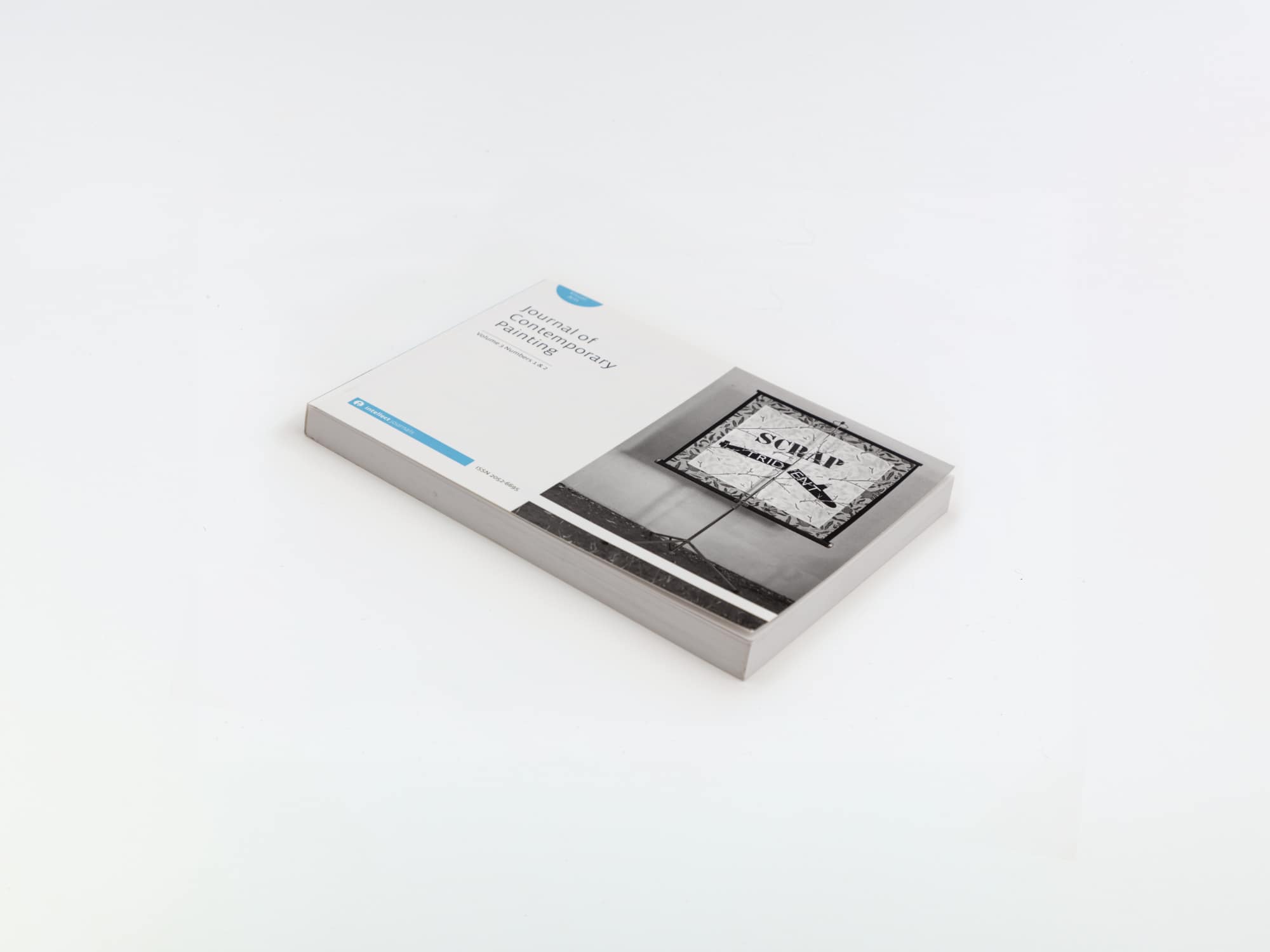
Daniel Pettitt reviews Mary Heilmann & David Reed: Two By Two at Hamburger Bahnhof, Museum für Gegenwart, Berlin, for the Journal of Contemporary Painting, Volume 3, Numbers 1 & 2 (Intellect, 2017). Written while he was studying painting at the Royal College of Art, the review considers the 2015 exhibition curated by Udo Kittelmann, which paired around 40 works by the two American painters spanning four decades.
The review
The exhibition opens not with paintings but with two films: Heilmann's Her Life (2006), a montage of her works alongside images of the ocean, gridlocked cars and neon signs, and Reed's Our Solitude (2014), made with his sister Pamela from stills of their old family home. Pettitt traces how these set up the show's sources, from the optimistic palette Heilmann terms 'Social Colour', which "has as much to do with food packaging as it does, say, De Stijl", to Reed's "nostalgia for the golden age of Hollywood manifested across interfaces of semi-transparent colour fields".
In the main gallery, each work is paired with one by the other artist, "the gallery space serving as a kind of white-cube-ark". Initially mooted to hang 'kissing', the pairs instead hang 'winking' at each other and the audience. Pettitt finds the show free of chronology and retrospective agendas: "There is no ego here." In an age shaped by social media, he writes, "the lack of self-consciousness found in Two by Two is highly refreshing."
Looking closely at individual pairings, Pettitt notes how in Heilmann's Yoshimi (2004) and Reed's #550 (2005–08) "background and foreground fuse into one flat surface, and negative space is not present." He follows Heilmann's twelve-seat Sunny Chair bench across the room to Reed's Scottie's Bedroom (1993), in which a Reed painting hangs above a bed beside a television looping a scene from Hitchcock's Vertigo, the same painting digitally inserted into the film.
The review also asks harder questions. The pairings offer "a slightly schizophrenic stereoscopic semaphore, visually consuming but a conceit that militates our ability to view and consider each work in its own right", and the show could prove a rocky introduction for those unfamiliar with either painter. Yet Pettitt concludes that nostalgia is "the enabler for this show but not the binding agent. Rather, affection and wit drive this exhibition. [...] This is not a show for soliloquies but for conversation and collision, something arrived at with accomplished precision."
Image: Journal of Contemporary Painting. Photography: Richard Ivey.
